
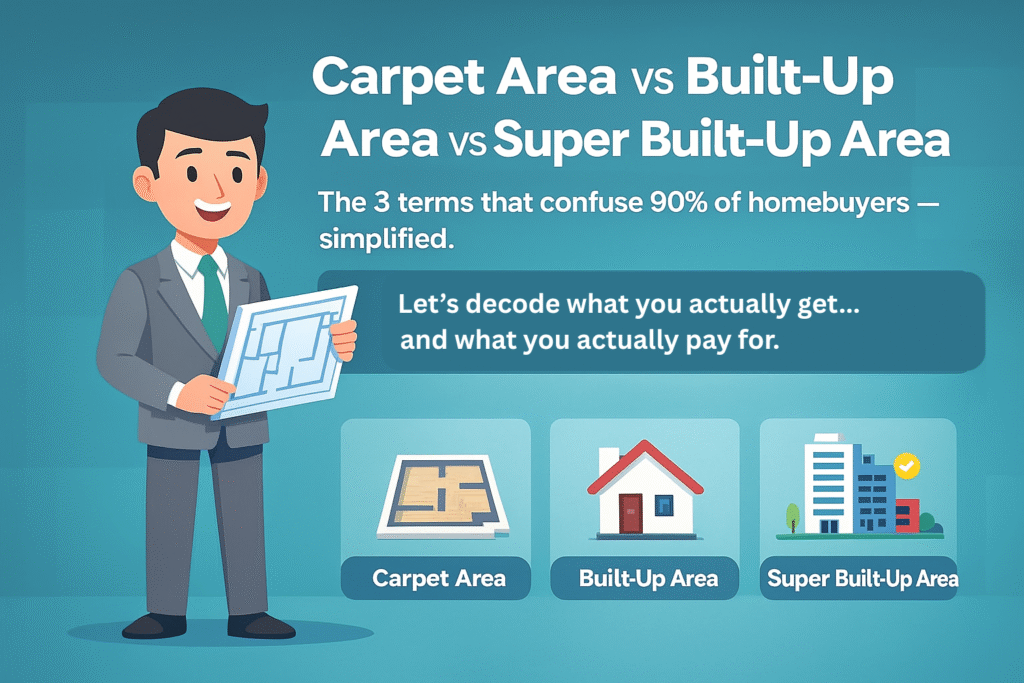
When you’re buying a home, terms like carpet area, built-up area, and super built-up area often create confusion — and sometimes lead to buyers overpaying without realising it. Understanding these measurements is essential because they determine how much space you actually get versus what you pay for.
Most developers advertise the super built-up area, but the carpet area is what truly affects your comfort, layout, and daily living experience.
This guide breaks down each term, shows you how to calculate them, and helps you make a confident, informed property decision.
Contents
Tap on a topic to jump directly to that section:
- What Is Carpet Area?
- What Is Built-Up Area?
- What Is Super Built-Up Area?
- Carpet vs Built-Up vs Super Built-Up Area (Comparison Table)
- How to Calculate Each Area (With Examples)
- Understanding Loading Factor
- Why These Measurements Matter for Buyers
- Transparency & Documentation You Must Check
- Final Word
- FAQs
1. What Is Carpet Area? (RERA Definition)
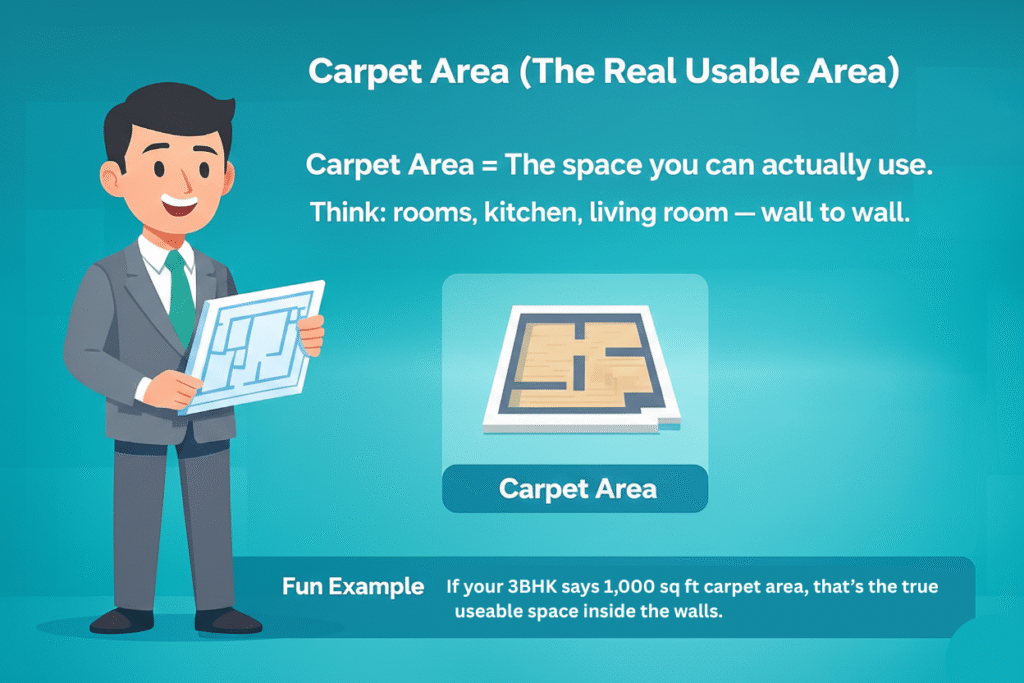
Carpet area is the actual usable area inside the home — the space where you can physically lay a carpet.
According to RERA, carpet area includes:
- Bedrooms
- Living and dining rooms
- Kitchen
- Internal passages
- Bathrooms and washrooms
Carpet area excludes:
- External walls
- Balconies and terraces
- Common areas
- Service shafts
In simple terms: Carpet area = usable living space inside your home.
2. What Is Built-Up Area?
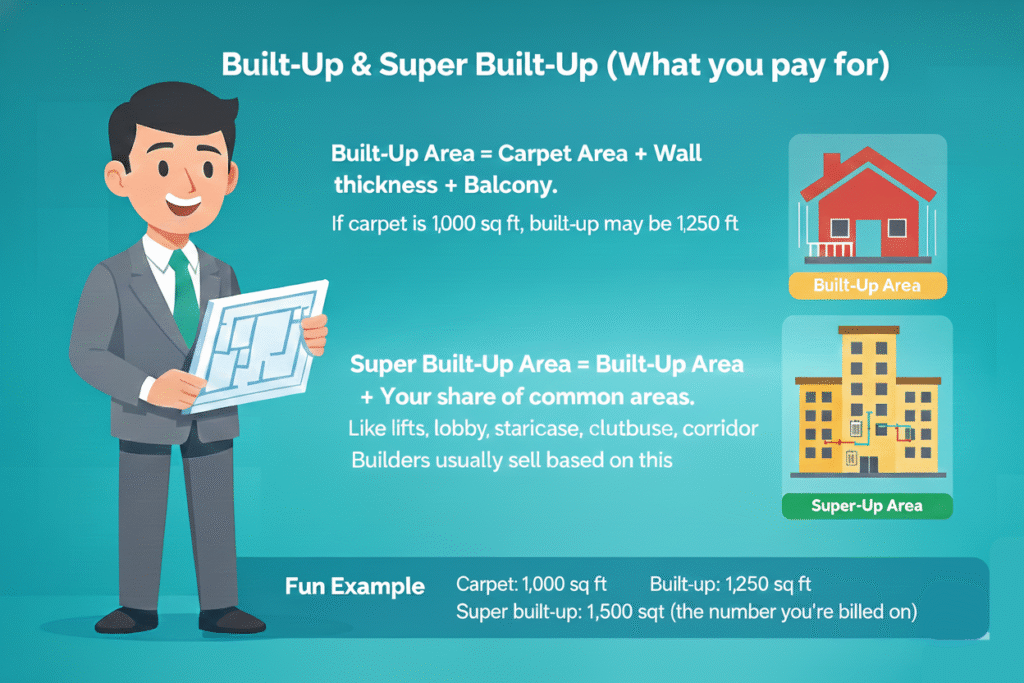
Built-up area expands on carpet area by including walls and some additional spaces.
Built-up area includes:
- Carpet area
- Internal and external wall thickness
- Balconies and terraces
It is always larger than carpet area because it includes spaces you cannot fully use, such as wall thickness.
Formula:
Built-up Area = Carpet Area + Wall Thickness + Balconies/Terraces
3. What Is Super Built-Up Area (Saleable Area)?
The super built-up area is often called the saleable area because this is what developers usually use to calculate the selling price.
Super built-up area includes:
- Built-up area
- A proportionate share of common areas such as:
- Lobbies
- Lifts
- Staircases
- Clubhouse
- Corridors
- Amenities and common facilities
Formula:
Super Built-up Area = Built-up Area + Proportionate Share of Common Areas
or
Super Built-up Area = Carpet Area × (1 + Loading Factor)
4. Carpet vs Built-Up vs Super Built-Up Area (Comparison Table)
| Feature | Carpet Area | Built-Up Area | Super Built-Up Area |
|---|---|---|---|
| What it includes | Usable internal space | Carpet + walls + balcony | Built-up + common areas |
| Usable? | 100% usable | Partly usable | Not entirely usable |
| Size | Smallest | Bigger | Biggest |
| Used for pricing? | No | Sometimes | Yes (standard) |
| Important for | Livability | Layout clarity | Cost calculation |
5. How to Calculate Each Area (With Examples)
Example Scenario
- Carpet Area = 800 sq ft
- Built-Up Area markup (walls + balconies) = 20%
- Loading Factor = 30%
Carpet Area Calculation
Measured directly using internal usable dimensions. Balconies are excluded as per RERA.
Built-Up Area Calculation
Built-Up Area = 800 + (20% of 800)
Built-Up Area = 800 + 160
Built-Up Area = 960 sq ft
Super Built-Up Area Calculation (Using Loading Factor)
Super Built-Up Area = Carpet Area × (1 + Loading Factor)
Super Built-Up Area = 800 × 1.30
Super Built-Up Area = 1040 sq ft
6. Understanding Loading Factor
The loading factor represents how much extra area is added to the carpet area to cover common spaces.
Formula:
Loading Factor = (Super Built-up Area ÷ Carpet Area) – 1
Typical loading factors:
- 25%–35% → Good project
- 35%–45% → High-density project
- 50%+ → Poor value
A higher loading factor means you pay more for space you cannot use exclusively.
7. Why These Measurements Matter for Buyers
a. Carpet area determines livability
It shows how much space you actually get for daily life.
b. Super built-up area determines pricing
Developers apply the per sq ft rate to the super built-up area.
c. Loading factor affects value
Two homes with the same carpet area may have different prices due to different loading factors.
d. Helps compare projects fairly
Super built-up area alone can be misleading — always compare properties on carpet area.
8. Transparency & Documentation You Must Check
Always verify the following before buying:
Mandatory under RERA:
- Carpet area
- Balcony & terrace area
- Built-up area
- Super built-up area
- Loading factor
- Detailed floor plan
- RERA registration and disclosures
Ask the developer for:
- Area calculation sheet
- Ratio of common area allocation
- Explanation for the loading factor used
Transparency protects you from inflated pricing and helps you compare projects more accurately.
9. Final Word
Understanding the difference between carpet area, built-up area, and super built-up area helps you evaluate the true value of a home. While developers market the super built-up area, it’s the carpet area that determines the real livability of your space.
Always compare properties based on carpet area, verify calculations, and insist on RERA-compliant documentation before making a final decision.
10. Frequently Asked Questions
1. Why is the carpet area more important for buyers?
Ans. Because it represents the actual usable living space inside the home. It directly impacts comfort, layout, and functionality.
2. Can carpet area and super built-up area vary between developers?
Ans. Yes. Different developers allocate common areas differently, which changes the loading factor and therefore the super built-up area. Carpet area, however, must follow RERA guidelines and cannot be manipulated.
Comments